Tuesday, December 20, 2016

The Year-end Checklist

1) If you have capital gains (inevitable, unfortunately, if your portfolio is growing) you may want to harvest some capital losses to offset those gains (if there are any). The good news is that you only pay income tax on 50% of your capital gains.  If your marginal rate is 50%, then for every $100 of gains you pay $25.

2) RESP contributions: the best way to maximize the Canada Education Savings Grant (CESG) is to pop $2,500 for each child into their respective RESP's and you will receive the $500 CESG per child about a month later. We strongly encourage folks to take advantage of this free money (it is not often that the federal government gives you free money). The cut-off is calendar year end (December 31). If you happen to miss a year, you can play catch-up in future years (1 year of catch-up per year).

3) While we tend to focus on TFSA contributions at the beginning of each year (with automatic client deposits) and you can always make up for missed contributions, remember that come January 1, 2017, if you have made any withdrawals in 2016, you can deposit them back plus make your 2017 contribution.

4) Charitable donations: December 31 is the last day for the 2016 tax year, whereby you can receive a federal charitable tax credit of 15% on the 1st $200 and 29% on any amount above the initial $200 (to a registered Canadian charity). for you really generous folks, you can only donate up to 75% of your net income (after deductions, before taxes). You can donate securities which will be valued at market prices (at the time of the donation) and not have to pay any capital gains tax. There some restrictions on certain securities.

Big thanks to High Rock Certified Financial Planning (CFP) professional Bianca Tomenson for her input.

Wishing you all a wonderful holiday season and a very happy, healthy and prosperous 2017!


Monday, December 19, 2016

Re-balancing Your Portfolio


Regardless of whether you believe in a more tactical approach to investing (as we do and is our Key Theme for 2017) or a buy and hold strategy that rides out the volatility over an investing cycle, none of it works if your portfolio doesn't get re-balanced.

If you have a balanced asset allocation, over the course of a quarter (or a year) the percentage allocations will shift and your portfolio will need to be re-balanced back to the originally assigned allocations. What is important about this operation is that strong performing assets are sold (profits taken as they have become over-weight) and they are re-distributed to purchase under-performing assets (that have become under-weight and cheaper). As the cycle progresses, over-priced, out-performing assets will return to more realistic prices and the same for under-priced, under-performing assets. 

The catalyst for this blog is from a meeting with new clients on Friday, disappointed with their buy and hold portfolio returns that had never (to his knowledge) been re-balanced (over a 4 year period). Full fees, limited client service.

Without this re-balancing process, a buy and hold portfolio will likely not provide better than benchmark (index) growth over longer periods of time: in other words why not just buy the benchmark index ETF and pay considerably less in fees.

If you have a buy and hold balanced portfolio and are getting non-discretionary financial advice, your advisor needs to call you (or you have to call him/her) to be able to enact a re-balancing (you have to give your permission for each trade). Needless to say, every client is not treated the same (from a timing perspective). Obviously the folks that we met with were not high on the list.

When you use a discretionary portfolio manager (see last Friday's blog for other differences: http://highrockcapital.ca/scotts-blog.html)
this is done automatically and simultaneously for all clients, so everyone is treated the same and fairly. 

You can add this to all the other benefits of discretionary portfolio management, but remember, this is not investment "advice", this is active portfolio management (by experienced portfolio management professionals with CFA and / or CIM credentials). 

At High Rock, we add in Wealth Forecasting by a Certified Financial Planning (CFP) professional, because every client has specific goals and objectives that are personal and their own. There is no cookie cutter, "one size fits all" strategy, because every family's circumstances are different.

If you really want to be looked after properly...
scott@highrockcapital.ca

If you would like to receive this blog directly to your inbox...
bianca@highrockcapital.ca

Friday, December 16, 2016

Small Investor Protection Association Report:

"Above The Law"

You do really need to read this:

The investment industry routinely uses the title “Financial Advisor” for their sales persons, whether they are selling mutual funds, insurance products (e.g. segregated funds), bank products (e.g. Principal Protected Notes), or acting as brokers to trade in financial products (e.g. bonds, shares, structured products).

Sales persons (dealing representative) have no legal requirement to look after an investor’s best interests. However, it is in the sales person’s interest to maximize his commissions. This can be done by selling the products that pay the highest commissions and by the use of leverage to increase the amount of assets under management (AUM) on which he generates commissions. Both of these initiatives are contrary to an investor’s best interests.


At High Rock we are licensed as a Portfolio Management Company with the Ontario, BC, Alberta and Saskatchewan Securities Commissions (OSC, BCSC, ASC, SSC) and held to a higher fiduciary responsibility that legally binds us to put the interests of our clients before our own.

This is a big distinction that is not necessarily always clear.

But it is enormously important.

See Rob Carrick's article in the Globe and Mail:

This is the alternative (different and better) that we offer:
Financial Planning (Wealth Forecasting), Portfolio  Management (with a tactical option) and a fantastic client service experience at a very reasonable cost.

It is the future of personal finance: ensuring that you are not being "sold" anything that might have a conflict of interest attached to it (like being paid a commission).

Soon, if not already, you will be able to see what your Financial Advisor receives as "commission" and you should take a good hard look at it and ask yourself if you are receiving the service that you are paying for.

You should also ask the Advisor if he/she is investing in the exact same assets that you are being put into (at High Rock we invest in the exact same assets as our clients and we even produce a quarterly report from an independent compliance service to prove this).

As you may have assessed, I am extremely passionate about the differences between true portfolio management and simple financial advice and I think it is important for everyone to have a full understanding of those differences.

Always happy to discuss that in more detail...

If you would like to receive this blog directly to your inbox...


Thursday, December 15, 2016

Canadian Household Debt: 
Need To Look Beyond The Headlines.


Record amounts of household debt in Canada are once again  catching the headlines of financial markets, however it is not time to panic, yet.

The good news is that asset prices are also rising and at a faster pace than Canadians are building debt (so debt has been productive):


The ratio of Debt to Total Assets is lower and has been coming down steadily since the Financial Crisis. In other words Canadians, as a whole, have generally been investing wisely.

As well the cost of servicing the debt (payments of principal plus interest as a proportion of disposable income) remains low at 14%.  

63.5% of Canadians total assets are financial assets (cash, savings, investments) 36.5% are non-financial assets (real estate for the most part).

So on the whole, household balance sheets are not in terrible shape.

However, the risks are pretty high because these are broad averages and studies by the Bank of Canada have shown that those who are more highly leveraged  (greater amounts of debt) are vulnerable.

If asset prices, either financial or non financial (or both) start to retreat, the debt to asset ratio will climb (as it did in the financial crisis) and debt becomes non-productive and a drag on household balance sheets.

Rising costs to service the debt (interest rate increases) will also take their toll and of course any threat to household income (employment) will also be a factor.

From a family wealth management perspective, when you are reviewing your own household balance sheet, you want to make sure that you have the liquidity to endure a short-term crisis (because, believe it or not they do happen) and be appropriately balanced. 

Over-exposure to any one asset class (especially real estate, where it is not necessarily so liquid) can be problematic.

Having the ability to be flexible and tactical, one of our key themes for 2017, is paramount.

That is why, prior to creating any investment strategy, you need to have a deep understanding of the composition of your net worth and within the context of your long-term goals, are able to withstand any short-term volatility so that your goals do not get derailed.

That is why we take the time and effort to understand our clients needs, goals, time horizon and risk tolerance long before we recommend an investment strategy. 

There is no "one strategy fits all", because everyone is different.

Canadians are in relatively good shape as a whole, but within the whole, there are plenty of vulnerabilities and they need to be protected. We can help.

Feedback...

If you would like to receive this blog directly to your inbox...


Wednesday, December 14, 2016

Fed Pulls Punch Bowl Away:
Trump / Santa Rally Arrested For DWI


'Tis the Season! (my apologies for using all the cliches).

As expected and to nobody's surprise the US Federal Reserve raised interest rates by 1/4%.

However, according to the new "dot plot" of FOMC member expectations, it appears that they are now looking for 3 rate hikes in 2017, which may be a bit of a shocker (and hence the reference to the punch bowl being pulled from the party). 


Certainly equity markets have been somewhat "over-served", what with all the Trump promises and still very accommodative monetary policy as they ran up a considerable 12 month forward looking Price to Earnings (P/E) ratio of 17.2 or thereabouts.

The CNN Money Fear and Greed Index blew close to 90!


That should be enough for a market to get "pulled-over"!

At least for the moment, anyway.

Our recommendation is to move forward responsibly: best check into our themes for 2017 from our client webinar at

Tuesday, December 13, 2016

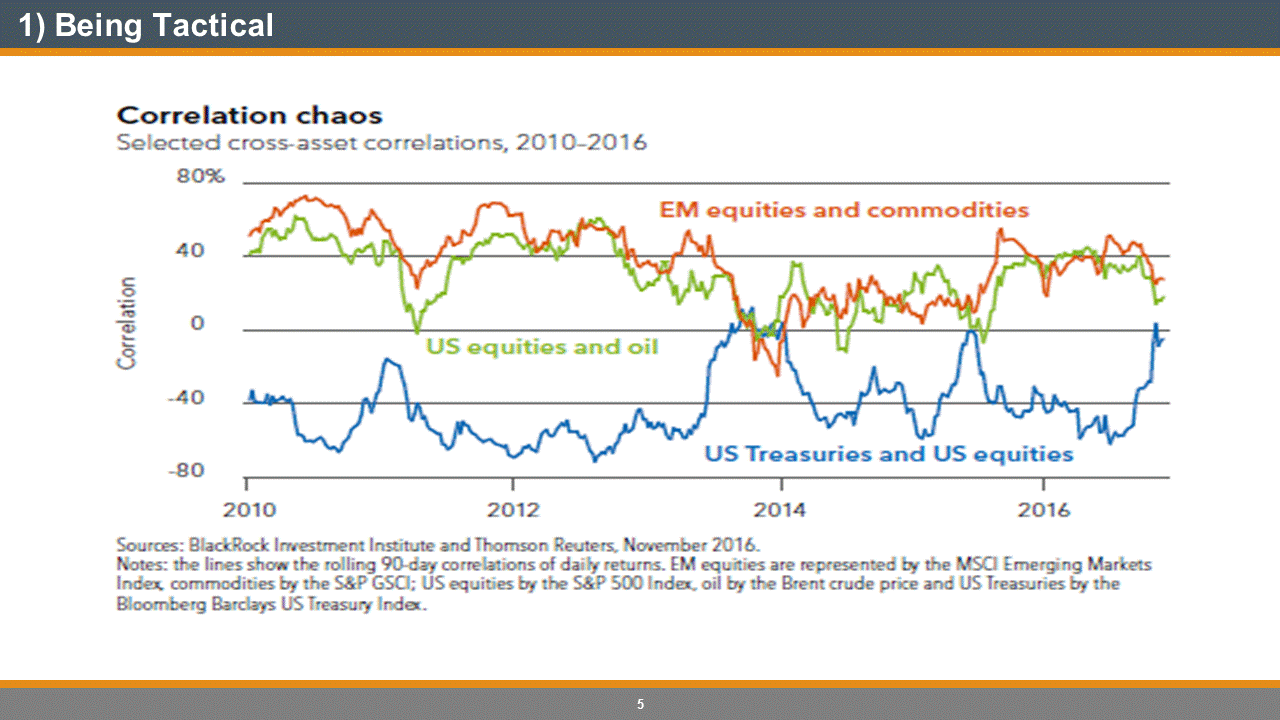
"The Old Rules Of Diversification Are No Longer Working"

(BlackRock Investment Institute: Global Outlook 2017)


As we at High Rock have been suggesting since the inception of our Private Client Division with the addition of a "Tactical" model to compliment our Fixed Income and Global Equity models for our balanced portfolios, back in April of 2015. BlackRock (iShares ETF's) confirms this in their Global Outlook for 2017, saying that: 

"We favour an active approach to investing as rising dispersion creates opportunities to identify security and asset class winners and losers".

Today on our final weekly client webinar we will discuss our themes for 2017 and how this will evolve our portfolio strategies for our clients and ourselves in the coming year.

The recorded version will be available on our website at or about 5pm EST later today.

Feel free to tune in and have a listen!

Monday, December 12, 2016

Tactical Portfolio Management Outperforms Traditional Buy And Hold In 2016.


For 2016, if you stuck with a traditional "buy and hold" strategy, you involuntarily likely took on greater risk than any time in the recent past because correlations between stocks and bonds flipped and when they reversed , bond portfolios (the usual "safe" investment) were crushed, while stock portfolios barely kept up and in doing so made risk-adjusted returns that much more vulnerable.

For the moment, that risk has actually increased because equity valuations (as measured by the 12 month forward Price to Earnings ratio at 17.1) are at the highest level since May 2015).


If equity prices "correct", without a bond market that rises in price in equal measure, the buy and hold balance will not be able to keep the additional volatility out of the portfolio as was the case throughout 2016.

With the most recent rally in stock prices, "greed" (from CNN Money's Fear and Greed Index) is at extreme levels:


Last year, "greed" peaked In late November and January and February were important tactical buying opportunities. This situation could easily repeat itself as we head into 2017. We were able to make some very strategic trades in the first half of 2016 that added significant value to our models in the second half of the year.

Almost 2 years ago we (at High Rock) introduced a tactical model to add broader scope to our investing process and our clients (and the High Rock management, because we invest in the exact same models) have benefited immensely from this, while at the same time reducing their/our exposure to unwanted volatility and lowering their/our risk profiles.

Last Friday we received an email note from a client with a simple "thank you". Nothing makes us feel better than to be appreciated.

Tomorrow we will host our weekly client webinar (the final one for 2016) where we will discuss our thoughts and themes for 2017.

Given the current investing environment and the changing world geo-political issues, more than ever we will have to be ultra careful with how we invest our and our client money and the buy and hold strategies that may have served investors reasonably well in the past, will likely be leaving them potentially even more vulnerable than they were in 2016.

Feedback...


If you would like to receive this blog directly to your inbox...