Wednesday, January 14, 2015

Hold On To Your Hats!


Volatility is up!


And what next for the S&P 500?

Technically: Key support for the up-trend from 2011 lies at or about 1900.
  • a technical breach of this level will likely see continued weakness and a potential test of the longer term support (up-trend from 2009) at or about 1600.
  • This is also close to the top registered in 2007 and (if it holds that level) will defend the theory that we are in a new secular bull market.
  • that would also be approximately 20% lower than current levels.
Otherwise, the S&P 500 will have to re-test up-side resistance at 2100.
  • and break-out to higher prices to keep the current up-trend (higher highs and higher lows) intact.
  • current price activity suggests that this will be difficult to accomplish,
Fundamentally: it is earnings season:
  • share prices have priced in continued positive earnings growth,
  • Q3 earnings blew out expectations,
  • Analysts have revised Q4 earnings expectations lower,
  • We are now at the beginning of Q4 earnings announcements,
  • time will tell,
Should you worry?
  • not if you have a balanced and globally diversified portfolio,
  • bond prices are rising and offsetting equity market volatility,
  • and remember: Central Banks do not like volatility and they will use monetary policy to try to keep financial markets from disorder.




Oil and Canada (part 2)

When the Bank of Canada speaks, we should pay attention!

Further to my comments yesterday:

Bank of Canada deputy governor Timothy Lane (who happened to be at the University of Western Ontario when I was studying Economics) spoke to the Madison International Trade Association in Wisconsin yesterday.

Drilling Down - Understanding Oil Prices and Their Economic Impact


Here are some salient points:

  • In Canada, oil extraction now accounts for about 3 per cent of our GDP and crude oil about 14 per cent of our exports.
  • The urbanization and industrialization of emerging economies and the growth of their middle classes is far from complete. China’s urban population has grown by about 300 million people since 2000 but, even now, only 55 per cent of its people live in urban areas, compared with more than 80 per cent for North America and advanced Asian economies such as Japan and Korea. According to some estimates, another half-billion people in China and India alone will move to cities and likely join a growing middle class over the next two decades. As long as these trends continue, they will add to world demand for oil.
  • Oil sands production rose fivefold between 1993 and 2014, to 2.3 million barrels per day, and now accounts for more than 60 per cent of Canada’s crude production. Between 2006 and 2013, investment in the oil sands more than doubled to over $30 billion.
  • Over time, these activities have delivered an outsized supply response, which has been driving prices down.
  • In all, it may take quite some time before supply and demand are brought back into balance.
  • prices can be subject to large overshoots in the short run, in either direction. The only true floor to prices in the short term is the short-run marginal cost, at which point producers would lose more money by continuing to pump oil from existing installations than by shutting it in.
  • For the world as a whole, the decline in oil prices is beneficial. If it is caused by new sources of supply, the price drop spreads the benefits of a favourable shock; if it is partly the result of slower demand growth, it mitigates the effects of an unfavourable shock.
  • The United States, as a net importer, will benefit from the drop in oil prices.
  • Other economies that are large net importers of oil, such as China, Japan and Europe, will also get a boost to their economic growth.
  • Canada, like other countries, has been trying to regain its economic footing since the global financial crisis. From the outset of the Great Recession, the Bank of Canada has been providing significant monetary stimulus. But we have yet to reach the point where growth is self-sustaining. For that to happen, the sources of growth will have to rotate away from consumption and toward increased exports, which are our traditional economic engine.
  • Signs of a broadening recovery have been emerging during the past year. Stronger U.S. growth and a weaker Canadian dollar have boosted non-energy exports. Investment spending and job creation have also begun to pick up, although significant slack remains in the labour market.
  • The most immediate impact will be positive: a boost to consumers’ disposable incomes and spending. Lower oil prices will also benefit many sectors, such as manufacturing, by reducing production costs. Our latest Business Outlook Survey, which was published yesterday, showed that more firms than in previous surveys are anticipating declines in their input costs, thanks in good part to cheaper oil and cheaper commodities in general.
  • Despite the mitigating factors I enumerated, lower oil prices are likely, on the whole, to be bad for Canada.
  •  The recent movements in oil prices have been dramatic, but they are not random. Once we sort through the different economic forces at play, we see that underlying the recent drop in oil prices is a surge in unconventional oil supply against the backdrop of slower growth of global demand. Over time, higher-cost oil is still likely to be needed to satisfy growing global demand, but prices could go lower, or remain low, for a significant period before those medium-term forces do their work.
  • These developments are among the most important that the Bank of Canada takes into account in making monetary policy. We will continue to work to bring the Canadian economy back to its potential and return inflation sustainably to our 2 per cent target. However things play out, we have the tools to respond.
Scott's Comments:
This  is not far-off from my commentary from yesterday:
The key takeaway here is that, if necessary, The BOC will use monetary policy to help alleviate the negative impact on the Canadian economic situation.

In other words: if lower oil prices hurt the Canadian economy, lower interest rates are to be part of the conversation.


Tuesday, January 13, 2015

What is driving Financial Markets?

1) Oil

The debate being waged in financial markets: 

Is the lower price for oil good for the global economy? And what are the implications?

It is certainly good for some sectors: the consumer which is 70% of the US economy  (and 63% of the Canadian economy) will certainly benefit from "savings at the pump".

Any industry that relies on transportation will certainly benefit from lower costs.

Not so good for the Energy Sector.

Perhaps not so good for financial companies with too heavy exposure to the financial sector.


2) Canada


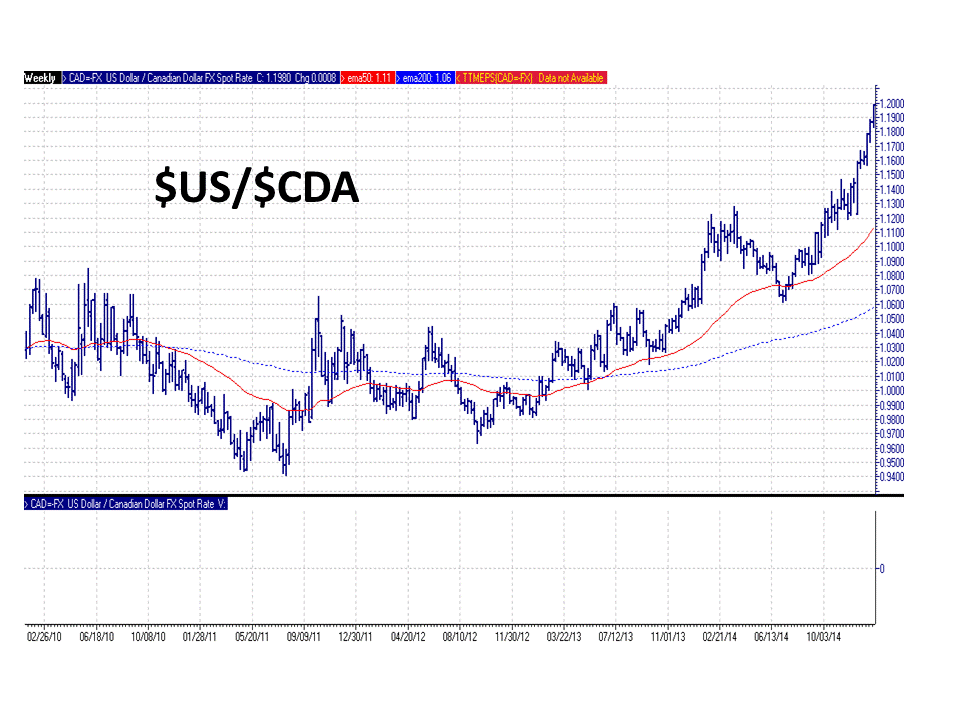
There is an "international" sentiment among financial market participants that Canada is highly dependent upon Energy as a major driver of its economy. In the short-term, this is a negative for the $C.

However, the lower $C is a major driver in making Canadian exports more affordable, so in the longer term, this is in fact a positive for the Canadian economy.

For the moment, however, short-term traders/speculators will have the upper hand, until the dust starts to settle.


3) Volatility


Financial Markets do not like uncertainty. Uncertainty forces investors to move away from riskier assets (an emotional decision, not necessarily a wise, thought-out decision) and this will increase volatility.

It is important to keep perspective, however. Even with the Volatility Index (VIX) close to 20 and well above last years lows near 10, it is nowhere near 40 level reached in 2011.

As difficult as it is to get "spooked" by volatility, the smart investor will not be fooled by the "noise" and keep a longer-term outlook.

Central Banks do not like volatility as it puts pressure on the consumer and business owner's confidence and makes sustaining economic growth that much more difficult.

Be rest assured, interest rates (as determined by bond markets and central bankers) will not be going up when financial market volatility is high.

We must always keep our long-term perspective.

Sunday, January 11, 2015

THE "MAGIC" OF COMPOUNDING


Rule of 72
  • In it's most simplified form: this basically means that by adding the growth of one year to the next and continuing to do so over a 10 year period, at a rate of return of 7% per year, you should be able to double the initial amount.
  • This is indicated by the red line in the chart above.
  • This does not include any additional amounts.
Add in some annual savings
  • The blue line takes into consideration the addition of some savings each year (in this case $12,000 per year, $1,000 per month).
  • Think about how that would look over 20 years (or longer!)
  • Powerful !!
Parents:
As the great Crosby, Stills and Nash once wrote in a song:

Teach your children well!!

Friday, January 9, 2015

Fiduciary Duty

What is this and how does it impact an Advisor/Client relationship?

This is profoundly important and the debate continues as to what should govern a relationship between a client an advisor:

From:

CANADIAN SECURITIES ADMINISTRATORS
CONSULTATION PAPER 33-403:
THE STANDARD OF CONDUCT FOR ADVISERS AND DEALERS:
EXPLORING THE APPROPRIATENESS OF INTRODUCING
A STATUTORY BEST INTEREST DUTY WHEN ADVICE IS PROVIDED TO RETAIL CLIENTS

October 25, 2012


Fiduciary Duty -- An Overview
A fiduciary duty is a duty of a person to act in another person's best interests.{5} For our purposes, a fiduciary duty applicable to an adviser or dealer means that the adviser or dealer (the fiduciary) would have to act in the best interests of her client. In general, acting in your client's best interest means that the fiduciary must ensure that:
• Client interests are paramount,
• Conflicts of interest are avoided,
• Clients are not exploited,
• Clients are provided with full disclosure, and
• Services are performed reasonably prudently.
More here: http://www.osc.gov.on.ca/en/SecuritiesLaw_csa_20121025_33-403_fiduciary-duty.htm


I know, it is easy to have your eyes "glaze over" when it comes to regulatory issues.

But anyone who is a client of a financial advisor has to ask themselves a key question: 

Is the person looking after me putting my interests first, ahead of their own interests?

and as an extension of this:

Am I being treated as an individual or as just another client in a large group of "similar" clients?

Are my goals and objectives the first priority?

Advisors do need to get paid for what they do, and perhaps those who do it better can charge a little more.

But when you make your decision to work with an Advisor, ask the difficult question (and make certain that it is the truth):

Where do I stand in your list of priorities?


Thursday, January 8, 2015

Tomorrow is Employment Data Day!

Usually, the first Friday of each month brings us the Employment Situation report from the US Bureau of Labor Statistics, affectionately known to traders and the media as "non-farm payrolls".


Why is this number so widely monitored?

1) The Federal Open Market Committee (the FOMC, affectionately referred to as "the Fed") has 2 mandates that it must focus on in determining the direction of monetary policy:
  • Inflation
  • Unemployment
Therefore, this represents the most recent data that the Fed will have for determining the direction of interest rates when it has its next meeting.

However, with each months new data come a whole host of revisions to the previous months' data (which can show some very large swings).

But traders ( with short-term views) will enter the market to trade based on what they think this data will represent for the future. This can cause an increase in trading volume on financial markets and an increase in volatility if they believe it might influence the Fed's decision.

Canada's Equivalent

At the same time (this month) Statistics Canada will report its latest data on Unemployment and Job Growth. 


The Media will jump on this data and analyze it upside and down because, it can be market moving.

However over the last year this data has had some extremely wide swings and some reported errors and revisions that have eroded its credibility.

How Do We As Investors View This Data ?

We put into context with our long-term view of investing: that any market movement and volatility associated with this data is temporary and short-term in nature. It is data fraught with errors and revisions and should be monitored, but one month's data should not change our long-term perspective.

All data is important in helping us gage the state of the global economy. However, as portfolio managers our job is to be in front of these data releases, having a pro-active approach, rather than a re-active approach.

Our asset allocation decisions come with understanding of how the global economy is evolving and what the implications are for our clients portfolios over the next 5, 10 or 15 years depending on individual client goals and objectives.

It is all about having perspective and not over-reacting to any news or hype.


Wednesday, January 7, 2015

Here Come The "Experts"

Bill Gross, the former manager of the world's largest bond fund:

“When the year is done, there will be minus signs in front of returns for many asset classes,” Gross, 70, wrote in the outlook. “The good times are over.”

VIX
  • He may be right (or not).
  • But it is only one year and therefore this is a short-term perspective.
  • The 60/40 balanced fund has enjoyed above average returns for 5 of the last 6 years (the historical long-term average, before fees has been approximately 7.5%).
  • 2011 was a slightly negative year and volatility levels were high (see VIX chart above).
  • So we are going to possibly get a year of lower returns at some point.
  • As Investors we have to focus on the long-term. 
  • Inevitably, over time, there will be economic forces that will have negative impact on global financial markets.
  • What we do not want in these times of higher volatility are big losses, because the recovery to get back to average returns takes significantly longer.
  • Anyone who is borrowing to invest is more susceptible because the downside will be magnified. 
  • Low interest rates made this a viable strategy over the last few years.
  • But as an investor you need to be very careful to impose discipline, wait for the negative markets to redeploy this strategy.
  • And of course that brings up the issue of "Market Timing".
  • Trying to time exit and entry points with certainty may work, from time to time, however the academic research suggests that it does not work over the long-term.
  • It may be a good strategy for putting "new" cash to work, i.e. waiting for market "dips", but for your whole portfolio: one "miss" can be extremely costly.
  • Of course, this is where an experienced portfolio manager can be extremely helpful.