Wednesday, March 1, 2017

Plenty Of Stuff For Financial Markets To Digest This Morning:

1) Pres. Trump's Address was positive in tone, but still thin on detail. Expectations for tax reform to be implemented may have to be extended.

2) European economic data continues to show improvement. Manufacturing index is at a 6 year high.

3) US Federal Reserve member speeches suggest increasing odds of a March 15th rate increase (to 71%).


4) US January core Personal Consumer Expenditure Price Index (which the Fed targets) rose 1.7% over the last year (below the Fed's 2% target).


5) Consumer spending in January grew at a pace that was less than expected.


However, after inflation is taken into consideration, "real" consumer spending was significantly lower.


6) Although household incomes were better than expected.

In a nutshell, forecasts for 1st quarter US GDP will likely be revised lower.

That might not be a good combination: lower than expected economic growth, postponed tax reduction and the Fed raising interest rates.

But at the moment that does not seem to be phasing the equity markets.

Stay tuned.

Feedback...

If you would like to receive this blog directly to your inbox...

Tuesday, February 28, 2017

Warren Buffett Says Fees Are Too High
We Agree


On February 15, I wrote a blog asking the question: "Are you getting value for what you are paying for?"

In his annual letter to shareholders (released last Saturday), Mr. Buffett took Hedge Funds and expensive money managers to task, suggesting that billions ($100B to use his number) have been surrendered to pay for relatively poor performance over the last decade.

In 2008, he bet that the S&P 500 (using a Vanguard index ETF) would out-perform a collection of "active" fund managers. It did so significantly and his bet winnings will be awarded to a charity of his choosing.

Why did the managers under-perform: fees and fees on top of fees.


Now, we at High Rock use a combination of index ETF's (in our Global Equity model) and individual securities (in our Fixed Income and Tactical models) to reduce MER costs to a bare minimum. That is one source of fees that is embedded or "hidden" and not required by the regulators to be fully divulged in a completely transparent manner. They only require those to be in the "microscopic" fine print at the bottom of a Fund Fact document that is sent when you buy a mutual fund or ETF. Many don't even look at the document, let alone the fine print. We have shown many of our prospective clients the difference on a weighted average basis and it has certainly turned their heads.

Are we "active" managers?

Only partially. We believe that the "average" portfolio manager will fail to "beat" the index that they are compared to for performance. We also think that our skill and deep research will guide us in making good tactical portfolio adjustments and re-balancings (to lower risk).

However, we also believe that Mr. Buffet is correct and at High Rock we always try to minimize fees and have reasonable exposure to the equity indexes for their long-term out-performance.

And don't forget the client service factors as well.

We are "stewards" of our clients wealth and that is what drives our day to day work. It is not just about collecting fees (as Mr. Buffett notes). It is about being paid for doing good work.

Mr. Buffett's letter: (start at page 20)


As part of our ongoing offering to clients, we will conduct a (shorter than usual) regular Tuesday client webinar, but with Mr. Trump's 9pm EST address of the US Congress tonight, there will be plenty of financial market "what ifs" that may alter the current level of volatility and we will spend more time on those details next week.
Tune in to the recorded version if you like: http://highrockcapital.ca/current-edition-of-the-weekly-webinar.html at or about 5pm EST for our latest update.

Monday, February 27, 2017

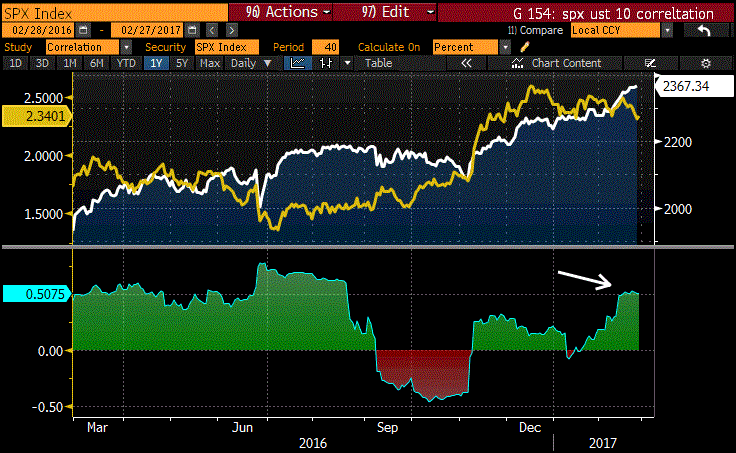
What Are The Bond Markets Telling Us Now?


We have often referred to the fact that the bond market (in gold on the above chart) leads all other financial markets (it was one of our themes for 2016).

10 year US government bond yields spiked following the Trump election reaching 2.6% in late December, more than 0.75% increase from pre-election levels (stocks, S&P 500 in white,
 followed bond yields higher).

This was a reflection of an expectation of significant fiscal stimulus (from the new administrations promises) and the potential for higher inflation (known as the "reflation trade") as well as an increase in potential bond issuance (more supply of bonds driving prices lower and yields higher).

Bond investors want to ensure that they are protected from potential increases in inflation which erode the real return on their fixed income stream of bond coupon interest (see last Friday's blog about Canadian CPI data for more on "real returns").

So with inflation fears in their psyche, they sold bonds in November, hoping to replace them at lower prices and higher yields.

Lately, however, bond investors have been picking away at replacing some of what they sold back in November pushing yields down toward 2.3% (as we explained to our clients in our Webinar last Tuesday, we were also doing a little buying) .

Why?

They / we are not fearing inflation quite so much.

Politics aside, we are all waiting on more detail from the Trump Administration on what fiscal policy will look like. That may come tomorrow when the president addresses congress. However, the lack of any of that detail to date (markets are not known for patiently waiting) has been slowly and gradually impacting the outlook and bond yields have slipped. 

Will stocks follow?

Stay tuned.

Feedback...

If you would like to receive this bog directly to your inbox...


Friday, February 24, 2017

Canadian Headline CPI Jumps
But It Is All Gas.


Canadian total CPI was 2.1% yer over year in January (quite a bit higher than the December reading of 1.5%), but up only 1.5% if you take out the impact of higher gas prices.

For those of you who drive, taking out the impact of gas prices may make little sense on your day to day lifestyle expenses.

For the Bank of Canada, who look at longer term trends in prices so that they can ensure that they are fully versed on their key mandate of price stability, the month to month volatility of some goods and services is not as significant.

In fact the "core" prices which the BOC focuses on (most preferred measure: CPI-common) in making their monetary policy decisions, remains below their 2% target.


Dipping from December's reading of 1.4% to 1.3% in January.

In a nutshell, there is no chance of an increase in interest rates at the March 1 meeting, Bank of Canada interest rate decision day.

Why does this matter?

For all of you variable rate borrowers, you can continue to comfortably stay the course.

As far as our Wealth Forecast assumption on personal annual average inflation at 2.5%, this still remains a relatively conservative estimation.

If you are getting an annual average (multiple year) return of 5% after fees and taxes, your net after inflation ("real") return is about 1% higher than otherwise assumed:

5% - 2.5% (assumed inflation) = 2.5%
5% - 1.5% (actual inflation) = 3.5%

That is a good thing!

Have a great weekend!

Feedback...

If you would like to receive this blog directly to your inbox...


Wednesday, February 22, 2017

Earnings Expectations Are Falling
While Prices Continue To Rise


On the surface the euphoria continues. Behind the scenes, analysts are lowering Q1 forecasts for earnings growth.

The full year expectations for earnings growth in 2017 have also been reduced from 11.5% at the beginning of the year to 10.2% currently (data according to FactSet).


This has brought the Price to Earnings (P/E) ratio to the highest level in 14 years at 17.6 times.


Which is well above the 14.4 times, 10 year average. 

At current levels, to get back to the 10 year average (and we know that in time most things revert back to the mean), either earnings growth would have to grow at about a 20% better than currently expected rate or prices would have to fall by about 20% (or a combination of both).

As we mentioned in our client webinar yesterday (http://highrockcapital.ca/current-edition-of-the-weekly-webinar.html): 

We are not interested in putting our clients into that kind of risk.

We would prefer to find assets with better value (via deep research) to invest in (and our track record shows that we have been able to provide a better return per unit of risk as a result).

That is our discipline.

And...the usual disclaimer... historical returns are no guarantee of future returns, but you know that at High Rock, we work darn hard to always provide the best possible risk-adjusted returns.

Feedback...

If you are interested in receiving this blog directly to your inbox...


Tuesday, February 21, 2017

Responsibilities To Our Clients:  
A Voluntary Code Of Conduct

Hoping that you all had a wonderful Family Day. My family provides me with my daily dose of inspiration: each day they plow so much energy into their lives, it truly does leave me in awe! It is all that I can do, just to keep up.

My life's work, to help other families reach their goals, especially their financial ones, is what drives my day to day existence and it is what I pour my energy into: trying to make their experience working with us as rewarding and fulfilling as possible.

This weekend, we (at High Rock) spent some of our time ruminating over how our commitment to our clients culminates in exactly how and why we interact with them.

First and foremost is our duty to, at all times, act for the benefit of our clients: we must always put their interests ahead of our own (which means that we can not have any conflicts of interest). 

Of course we do need to be paid for our work (we have expenses to cover and tables to put food on), but it should be completely transparent to our clients as to what they are getting for the fees that they pay.

Our investment strategy for each client and client family needs to be specific to their particular circumstances: their objectives, their tolerance for risk, the time horizon required to achieve their goals, their need for liquidity and cash flow, any financial constraints or other relevant information that might affect their investment policy.

We call this preparation a Wealth Forecast (and I have written frequently on the need for a plan and the fact that without a plan, it is not possible to properly create an investment strategy).

This is what drives our High Rock mission statement: that "managing a family's wealth is about three things and we strive to do all three extremely well".

Planning is the beginning.

Investment management is the essence of what we do: based on deep fundamental research (both micro and macro) and keeping our "ear to the track". We act with skill, competence and diligence to have a reasonable and adequate basis for all of our investment decisions.

This is not financial or investment advice. It is portfolio management, which at all times is  based on getting the best possible risk-adjusted returns (another topic which I have come back to on numerous occasions in this blog) for our clients within the framework of their Wealth Forecast.

The only way we can create credibility for our actions is by investing in the exact same assets as our clients. If we don't buy them for ourselves, how could we justify buying them for our clients if we truly put their interests ahead of our own.

Just to ensure that we do what we say, we have an Independent Review Committee that reports directly to out clients each quarter to provide this comfort.

To deal fairly and equitably with every one of our clients, all transactions occur simultaneously for everyone and clients receive their "fills" before we do.

The third and equally important facet of our responsibility to our our clients is communication: 

To make it relevant, a Wealth forecast needs to be monitored, reviewed and updated. At a minimum this should happen twice per year. At the same time, a client's investment strategy has to be reviewed and adjusted accordingly.

Quarterly portfolio summaries and client notes are part of the communication process as are frequent blogs and our 24 /7 availability.

There you have it, a lot of what makes us unique (different and better), inspires trust and drives our effort to be the best that we can be for our clients.

Our conduct is how we roll. That is our discipline.

Feedback...

If you would like to receive this blog directly into your inbox...


Friday, February 17, 2017

 Capital Gains Tax: Whispers Of An Increase


You may want to have a look at the article above, but basically, it says:

Gluskin Sheff + Associates chief economist David Rosenberg says he has been hearing whispers that the federal Liberals will table a “soak the rich” budget in the weeks ahead – one that includes a steep hike in the tax rate on capital gains.
Mr. Rosenberg said in his morning note that the capital-gains inclusion rate could rise to 75 per cent from the current 50 per cent, which has been the rate since 2000. Returning the rate to that level, combined with the most recent uptick in the top marginal personal income tax rate, would mean that Ontario investors would pay as much as 40 per cent tax on capital gains.

This would be significant. If your "buy and hold" strategy has amassed a large unrealized capital gain in your non-registered (sometimes referred to as a "cash") account, you may want to have a chat with your accountant about the ultimate implications. Especially if you are retired and rely on the sale of non-registered assets for your cash flow. It will certainly have implications for your estate or any other circumstances where a "deemed distribution" (deemed to have disposed of/sold assets) might be necessary.

Depending on how this scenario is phased in (if in fact it actually happens) it could have serious implications for the selling of stocks, bonds, ETF's, mutual funds and secondary (investment) real estate. Needless to say, the impact on these asset prices would be negative.

It is why a Wealth Forecast is a dynamic process or "working model" (monitor, update, re-assess) because as new scenarios evolve in your financial life, you want to be able to build in those new scenarios (and assumptions) to understand how this will impact your net worth into the future.

Of course this is pure speculation at the moment.

However, it is better to be prepared than to be caught of guard, if it actually does happen. 

Feedback...

If  you would like to receive this blog directly into your inbox...