Thursday, April 13, 2017

Protectionist Policies Are The Big Risk For The Bank Of Canada Outlook


Not necessarily "fun" reading for the weekend, but if you are at all concerned about interest rates, what may likely happen next and why and when, (and whether to float or fix your mortgage or HELOC), you may want to have a peek at the latest Monetary Policy Report put out yesterday by the Bank of Canada.

You may note that the usually more upbeat report (for the last few years the Bank of Canada has issued somewhat more positive views than what has actually occurred) is not particularly so this time around: basically discounting recent economic improvements as temporary and painting a fairly cloudy and uncertain view of the future.

Most of that has got to do with the lack of certainty of US policy initiatives, but also the tendency to view the rise of protectionist policies as potentially economically disturbing:

"An increase in protectionist policies could, depending on their degree and extent, have a significant impact on the Canadian and global economies. The rapid pace of trade liberalization from the late 1980's to the early 2000's helped increase global economic growth."

"A notable global shift toward increased trade protectionism would pose a risk not only to short-run demand but also to long-run growth and prosperity. A move to a significantly less-integrated global economy could also involve a lengthy adjustment process and could require difficult reallocation of workers and resources across industries."

Needless to say, under these conditions it is hardly likely that the BOC is going to be raising interest rates any time soon.
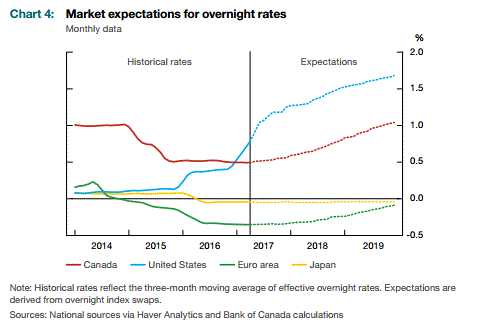

Even if US interest rates are expected to go higher, don't necessarily expect Canadian rates to keep pace.

For our (High Rock) clients we have to consider all the risks (part of our diligence, deep research and discipline), which in some cases are not always obvious, especially when the "animal spirits" of optimism are forging ahead with emotion.


Feedback...

If you would like to receive this blog directly to your inbox...

Tuesday, April 11, 2017

Fees

Investors large and small deserve to be treated with respect.

 When the mutual fund management industry pays advisors to sell their funds, investors deserve to be told exactly what the costs are that they are bearing and what they are paying for.

Perhaps the advisor should also have to justify the portion of what he gets paid to sell that particular fund (known as the "trailer" fee) as well.

A fee-based advisor does not receive a trailer fee. The client will pay the firm that he works for a % of the total of the client's assets under administration (based on a preset %) and the firm will then pay a commission to the advisor (usually in the vicinity of 40-50%).

Nonetheless, as a client, you should still know what you are paying and exactly what you are paying for.

I just sat through a very interesting webinar with the Ontario Securities Commission folks about the Consultation on the Option of Discontinuing Embedded Commissions (CSA Consultation Paper 81-408). CSA is the Canadian Securities Administrators who are charged with coordinating regulation among the various provincial and territorial securities commissions.

The general premise is that what are known as MER's (or management expense ratios, i.e. the "embedded" or hidden cost of mutual fund fees) have inherent conflicts of interest when a portion of this is paid back (from the fund company who collects them) to the advisor who sold them in the first place.

The problem is that the advisor is not required to share this information up-front. It is usually buried in the prospectus or information memorandum or the tiny print on what is called a Fund Fact document.

Even ETF MER's are not required to be disclosed. If you have a "low cost" portfolio of ETF's you could easily be paying an additional 35-50 basis points or more on ETF MER's above and beyond your advisor's fee. Unless you do the background research, you may not know this at all, because your advisor is not required to tell you.

If you are working with an adviser (there is quite a difference between a  financial or investment advisor with no fiduciary responsibility and a licensed portfolio management company and advising representative or adviser, with fiduciary responsibility), all of this would have to be disclosed.


Key words in the above link: Title Trickery. It is worth a read.

We are adamant about disclosing all of our fees/costs to our High Rock clients.

But we are only in the category of 3% of advice givers required to provide that kind of transparency.

So the CSA is exploring the option of ending embedded fees because they have potential conflicts of interest. They have been doing so since 2012. The financial advice industry is fighting this. They claim that if investors knew the costs that they may not seek advice. They call that a potential "advice gap".

Well there is no "advice gap" at High Rock's Private Client Division:

You pay a fee of 1%. With that you get a financial plan (prepared by a CFP professional): your Wealth Forecast that shows you (with some general assumptions) what you can expect to save, grow and have for your future and your estate. You get some of the best portfolio management available (where we actually manage the money "in-house") that focuses on risk and long-term returns to compliment all of your financial goals that are revealed through your Wealth Forecast. You get regular monitoring of your progress and guidance with changes that may come about as time progresses.

You pay an additional 0.15% for the custodial (account maintenance and back-office) services and safety (Canadian Investor Protection Fund, CIPF) of Raymond James Correspondent Services.

You may pay between 0.05% and 0.10% in ETF MER's (as a percentage of your total portfolio), depending on the structure of your asset allocation.

Total cost = approx. 1.25%

As a comparison, the RBC Balanced A fund (with $5.2B under management) has an MER of 2.16%. And what do you get for that fee?

Just asking.

There is an alternative and we have been leading the financial industry in a different direction for two years:

http://business.financialpost.com/news/fp-street/high-rock-capital-management-leads-the-charge-on-fee-disclosure


Feedback...

If you would like to receive this blog direct to your inbox...

Sunday, April 9, 2017

Truly Client First


When my High Rock partner, Paul and I first sat down to map out the strategy for our Private Client Division over two very short years ago, we were faced with a pretty significant undertaking: how, in a world of fairly skeptical  savers and investors, were we going to be able to turn enough heads to be able to show the world that we were going to do something that was different and better?

 I was challenged by not being a slick salesperson.  I don't have the stomach for rejection: "cold calling" was out of the question. Looking back at my past, I saw that all of my previous relationships were built on referrals and over a long time. Paul and I have extremely complimentary skill sets: he is a master financial analyst, with a great eye for value and I loved helping people to manage their financial risk. Between us we felt that we had a foundation of incredible strength to come up with a very strong offering indeed.

Surely there was a way to get noticed and lead the wealth management industry out of its current wilderness. Basically, the biggest conflict of interest of all: financial and investment advisor's who put their interests (their commission income and "book of business") first. 

There is lots of "lip service" paid to making clients feel important, but I have been on the other side, I have seen it first hand and it is far from putting the client first.

We built our website, we took to writing blogs (neither of us are "trained" writers, something that is definitely not in our respective set of skills, although we try) and we asked those that knew and trusted us to let others know what we were up to.

Somehow, we had to break through the automatic trust that is generated by the "big" 5 or 6 banks and other financial institutions (and their very hypnotic marketing efforts) to show that our desire was considerably more wholehearted and earnest.

We don't have the big $ to compete with those marketing efforts and if we did, we would rather use them to reduce our clients fees or spend more giving back to the communities that we live in.

When markets took a tumble in early 2016, we were overwhelmed with folks seeking us out, literally we could barely keep up with the number of new clients.

That was a huge compliment. That was trust. That we became the people to turn to when things looked a little scary.

The nature of our style of managing risk means that we will never out-perform when stock markets are on the big up-swing, but when they turn south, we and our clients will be well-protected. We know that recovering from a significant sell-off (and it will happen again) is a great deal easier when you are strategically prudent.

But that is what it means to put client's first. To truly care enough to not put them at significant risk or better than that, to take them out of harms way before it falls on us (usually unexpectedly). Yes, there is risk in every asset that has the potential to return better than 90 day Government of Canada treasury bills, but knowing how to manage that risk for the long-term is what really matters.

Not too many in the financial advice business care about that. They care about revenues and shareholders.

We care about people and families.

http://highrockcapital.ca/index.html


Feedback...

If you would like to receive this blog directly to your inbox...

Friday, April 7, 2017

Employment / Unemployment

In The US:


US Non-farm Payroll employment grew at a less than expected pace of 98,000 in March. And as I say about this data each month, it will be subject to possibly significant revision:
January data was revised lower by 22,000 and February (remember all the hoopla?) data was revised lower by 16,000. So as we like to do, to smooth out the monthly swings, look at the 12 month moving average (in pink) and it continues its decline from its peak in early 2015. US job growth is trending lower.

The unemployment rate dropped to 4.5%: 


So there is no imminent concern about a US recession until the current rate moves above the 3 year moving average, currently at 5.3% (but falling rapidly).

Wages are not growing rapidly, which may give the Federal Reserve some pause to reflect:


Now, with consumer spending expected to slow further, GDP for the 1st quarter of 2017 is anticipated to come in at only a 0.6% rate of growth, way less than earlier expectations (See Paul's blog... http://highrockcapital.ca/pauls-blog/is-the-fed-making-a-policy-error )

Risks are rising.

In Canada, the number of employed rose by 19,000 (a bit more than expected) but as more people were looking for work, the unemployment rate inched higher to 6.7%.

We do not see any change in current Bank of Canada policy. So stay variable on your mortgage (or HELOC), it continues to cost less than fixed and longer dated maturities (based on bond yields) are lower than they were at the beginning of the year.

Feedback:

If you would like to receive this blog directly to your inbox...

Thursday, April 6, 2017

Responsibility to Clients

If you have not yet read the Small Investor Protection Association (SIPA) report: "Web of Deception"  http://www.sipa.ca/library/SIPAsubmissions/WEBofDECEPTION_2017.pdf  please take the time. It is such an important document and it will hopefully catapult the issue of fiduciary responsibility to the forefront. You definitely want to pass it on.

We started High Rock Capital Management's Private Client Division http://highrockcapital.ca/private-client-division.html to lead the industry forward as far as our responsibility to our clients is concerned.

To this day we still meet with prospective clients who are under the false impression that their advisor has to put their interests (as client's) first (ahead of their own, as advisors), when that is not the case.

As the "Web of Deception",  reports, only 3% of all licensed advisors do. So what are the odds that your advisor does not?

Needless to say, we (at High Rock) are always looking for ways to show how we are different. In January of this year, before the CBC GoPublic unveiled their reports and the SIPA report was released, we were busy working on a document that would help elevate our ethical approach to our clients (and show that we hold ourselves to a higher standard than most of the rest of the financial services industry), hence: 

Our Voluntary Code of Conduct for the Stewardship of Your Wealth, 

Which we have posted on the first page of our website http://highrockcapital.ca/index.html

All of our clients will receive this signed document (as an attached pdf) with the quarterly updates that they will be receiving over the course of the next week, but we are excited to share it with you today because it does truly reveal our desire to properly dedicate ourselves to the higher level of client care that we are espousing.

Enjoy!

Questions, Comments?

Tuesday, April 4, 2017

Absolute Returns Or Risk-Adjusted Returns?


What stands out the most when you look at the slide above?

1 Year = 15.40%

Now who wouldn't want that return for their portfolio?

That is the absolute return or (total return) of the All Country World Index (ACWI) ETF for the 1 year period (according to Bloomberg TRA, daily basis). A broadly diversified index of global stocks, which is about 50% US equities, 8% Japanese equities, 7% UK equities and 3% each of Canada, China, France, Germany 

The next question you need to ask yourself is: what sort of risk am I prepared to take to get that return?

The 1 year period from March 31, 2015 to March 31, 2016 total return for ACWI was -4.28%.

That gives you a 2 year total return (Bloomberg TRA, March 31, 2015 to March 31, 2017 on a daily basis) of 5.09% and 5.11% on a monthly basis (table below).

The return per unit of risk (risk-adjusted return) over the 2 year period (table below) on a monthly basis was 1.09 times.

A "gambler" might look at the absolute return and say to himself: "I want some of that!!" And of course that is what drove retail investing in the first quarter of this year. "Gambler's" chasing returns, throwing caution to the wind.

A "steward" of his family's wealth, would be more circumspect and approach investing with a longer-term outlook and a more balanced portfolio with a fixed income component for safety (even though bond returns have been a little less than impactful over the last couple of years):


A "steward" of  his family's wealth who came to High Rock 2 years ago when we started our private client division would have experienced a balanced portfolio with a tactical option  that has had significantly less risk, but very strong returns per unit of risk taken:


Even compared to a "buy and hold" 60/40 portfolio over the same period, the actual High Rock private client portfolio (after adjusting for fees) outperformed on an absolute basis and on a risk-adjusted basis (return per unit of risk taken). Making the case for the tactical option in a portfolio.

If you want to gamble with your family's wealth, it is your money, do as you wish. If you want to invest to maximize your long-term growth and minimize the downside risk, you might wish to give our tactical option a thought or two, because it works.

We will discuss comparative returns, the global economy and financial markets on our weekly webinar with our clients today. We will post this webinar on our website at about 5pm EDT:


Saturday, April 1, 2017

An Absolute Must Read For Anyone With A Financial Advisor


"This report is meant to provide an overview of some of the deceptive practices with concentration on the sales of investment products. The same practices prevail throughout the financial services from the up-selling of bank services and selling insurance products to the selling of securities that include shares and mutual funds".

It is almost the second anniversary of High Rock Capital Management Inc.'s Private Client Division (High Rock Capital Management was founded in 2010) which we established to provide families with a better alternative to that which was available to them from the mainstream bank and financial industry advice channel, because from our experience so many investors were being taken advantage of. 

I had seen this first-hand! And hence the birth of our Private Client Division as I left the "old-school" to help lead the next, more open and transparent chapter in financial services.

"In SIPA's report "Advisor Tiltle Trickery", there were 121,932 total registrants in Canada as of Sept. 16, 2016 in the investment industry. 4,076 person's or 3% of that total are legally registered in the category of Adviser or Adviser Representative. Only 3% are registered in the category where a true fiduciary professional relationship is legally required to be delivered to you as the investor."  

"All others are registered as Dealing Representative, i.e. salespersons who legally act as an agent of the dealer, and NOT firstly an agent of the investor. Client relationship rules currently allow this to be hidden from your view, and the investor is expected to be responsible for learning this. This bait and switch is a root cause of a great deal of harm being played out on nearly every Canadian investor."

High Rock is licensed by the Ontario (BC, Alberta and Saskatchewan) and as a Portfolio Management Company and an Adviser Representative which holds us to the higher responsibility of Fiduciary.

We do go above and beyond the required regulations with an Independent Review Committee (an outside compliance firm) who polices us as far as reporting back to clients on outstanding complaints (of which there are none) and any possible conflicts of interest as well as to ensure that our partner portfolios hold the exact same securities and same entry and exit points as our clients.  http://highrockcapital.ca/uploads/3/4/2/5/34254660/hrcmi_ircreview_december2016.pdf

To the best of our knowledge, we are the only portfolio manager in Canada, managing client money on an SMA basis who has this.

So my question to any of you who may be reading this:

Why would you choose to settle for the lesser quality advisor? It can't be the fee (our fees are as competitive, if not more so).

Our long-term performance is better than our benchmark average (and we take less risk to do so).

Obviously trust is a huge issue. Are you certain you are not misplacing your trust? Do you really know your advisor?

Ask the questions.

We are the alternative.

Feedback...

If you would like to receive this blog directly to your inbox...